
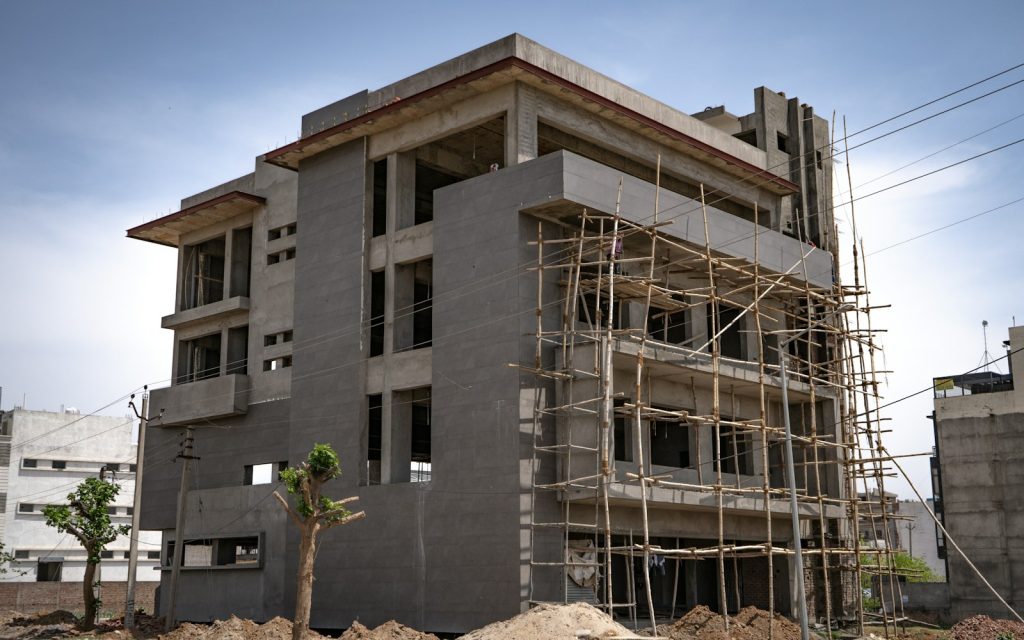
When I teach people how to examine a real estate deal, I keep coming back to this phrase: lift the hood.
Most of us look at the result — an apartment that costs two and a half million shekels, a new building, a sought-after neighborhood — and try to decide whether the price is good. But what interests me is a different question: what happened along the way that turned land, planning and construction into a property worth so much? And at which point along the path was a significant part of the value created?
If my goal is to grow my equity — for example, to turn one million shekels into two million — I do not want to rely only on apartment prices in Israel rising. I want to understand through which mechanism my money can work, how long it needs to work, and what I am risking in order to get there.
Two mistakes that hide the engine from us
The first mistake is generic price comparison. We see an apartment at two and a half million shekels, compare it to similar apartments and ask whether we got a discount. But we rarely break the price down into its components: land, rights, planning, levies, development, construction, financing, taxes and developer profit.
The second mistake is building the deal on a future rise in market value. I like to say: a good deal should not rest only on the hope that prices will be higher in a few years. If the market rises, it can lift many other properties too; and if it falls, it can damage the whole plan.
We want to identify a mechanism that can create an advantage already at the point of entry — not just hope that the wind blows in the right direction.
The journey of the property: from land to keys
To understand where the money is, I like to lay out the whole path in front of people: land with an existing rights status; advancing a plan; plan approval; detailed planning and permit; development and construction; handover of keys; sale of the finished apartment.
Not every stage behaves in the same way. As rights become clearer and the possibility of realizing them approaches, one uncertainty may diminish and the value may change. But at the same time new costs, levies or constraints may emerge. A planning process can also be delayed, altered or fail to receive approval.
Where does the value jump?
In some deals, the major jump in value happens precisely around planning and value enhancement: when the land changes its potential use, and when the rights become clearer.
In one scenario I sometimes present to students, three years of value enhancement may produce an increase in value of 50%–100% on the invested capital, while three years of waiting at the execution stage may yield only a market rise of 5%–10%. These are not typical or guaranteed rates of return, and there is no basis to assume this will happen in every project. It is an illustration of a question that matters to me: not only how much can be earned, but at which stage, within how long, and with what risk.
It must be remembered: the chance of a larger jump in value at an early stage is sometimes exactly the compensation for higher planning, legal, financing and liquidity risk. If the plan is not approved, if the number of units is reduced, or if additional years are needed, the result can be very low — even a loss.
So the smart question is not “where is the biggest return?” but “where is there an appropriate balance between the potential value, the time and the risk that I know how to bear?”
Why buying at a later stage changes the economics
When we buy land after a plan has been approved, or an apartment “on paper” from a developer, some of the risks have already been removed — and that is usually reflected in the price too. Whoever advanced the planning or bore the risk beforehand expects to be compensated for it.
After the rights are approved, the developing and execution work remains: licensing, construction, management, financing, marketing and sales. There is also potential profit there, but it depends on costs and on the actual sale. Sometimes I illustrate a possible developer margin of 10%–15% at the execution stage; this is an illustrative range only, not a ceiling and not a uniform figure for every project.
The implication is that once we buy an apartment at market price, we are not necessarily buying the same opportunity that existed for someone who entered before the planning advanced. We are buying a different product, at a different price, with different risk.
What does a two-and-a-half-million-shekel apartment teach us?
Suppose the market price of an apartment is 2.5 million shekels. Buying it at 2.5 million shekels — or slightly less — can be a very sound decision for living in or for certain investment purposes. But in itself it does not create a significant entry appreciation margin.
On the other hand, if we manage to structure a deal in which the total cost of a property whose value based on the market is 2.5 million shekels is 1.8 million shekels, there may be an economic gap of about 700 thousand shekels. That gap is not cash profit on the day of signing. It has to survive appraisal checks, taxation, financing, expenses, time, risk and liquidity — and only then can we estimate what is really left.
But there is another side to the equation: people tend to think that a finished apartment or a leveraged apartment is necessarily the safest route. An apartment also carries market exposure, especially if a significant loan is taken against it.
If I bought an apartment at 2.5 million shekels with equity of 625 thousand shekels and a mortgage of 1.875 million shekels, and the value of the apartment fell by 10%, that is a drop in value of 250 thousand shekels. Ignoring expenses and principal repayments, that is an erosion of 40% of my equity. Leverage multiplied the effect of the price movement on my capital fourfold. That is why a 10% move in the market is not necessarily a 10% move in the investor’s pocket.
But this argument must not be turned into a claim that early-stage land is safer than an apartment. Land before a plan is approved can be less liquid, harder to price, and exposed to the risk that the expected rights are never granted at all. Each stage has a different risk, and our job is to understand it — not to hide it.
Extracting the value of the land: the number beneath the number
Rather than settling for the price of the finished apartment, we can ask what share of it is the value of the land.
One of the professional methods for valuing land for development is the residual method, or extraction method. You start from the expected value of the finished project and subtract the expected costs: construction, development, planning, levies, marketing, financing and the required developer profit. The remainder helps estimate the value of the land.
This is not mathematical magic. A small change in the assumed apartment prices or construction costs can change the result considerably. But the method allows us to understand what really drives the price, and what has to happen for the appreciation to materialize.
Two more engines: financing and taxation
The first engine is financing. Should we work with equity, debt, a partner, or payments in stages? At what point do we bring in investors or sell partial rights? Every decision affects the return on equity, the cost, control and risk.
The second engine is taxation. Sometimes the structure of the purchase, and whether we buy a finished apartment or a right in land, affects purchase tax and the overall burden. For example, on the purchase of an additional residential apartment an initial purchase tax rate of 8% may apply, while acquiring a right in real estate that is not a residential apartment is generally subject to a rate of 6%, with certain provisions and reliefs. But separating the land from construction services does not guarantee that tax applies to the land alone: the substance of the transaction, and in particular certain arrangements in purchase groups, may lead to a different calculation. Every structure must be checked with professionals.
Financing and taxation do not replace the appreciation engine, but they can dramatically change the bottom line of the same deal.
What do I want you to ask before the next deal?
When someone presents a property to you, do not settle for the question “how much does it cost?”. Ask: what has created its value until today? What might create its value tomorrow? Which stage of the path is already priced into the price? What risk remains? How long will my money be tied up in the deal? And what will be left after all the costs?
That is the difference between buying a price and understanding an engine.
In my view, a good developer does not need to predict the housing market. He needs to know how to break a deal down, understand where it is likely to create value, identify what could go wrong, and build the structure that suits his goal and his capacity.
Before you buy the car — lift the hood.